

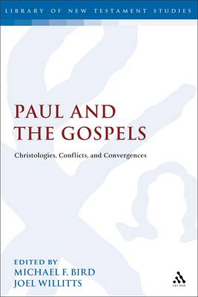
 One of my main interests in New Testament studies is the relationship between Paul and the Gospels. So in the next few posts I will be summarizing and commenting on each article that is found in the new book (surprisingly) titled Paul and the Gospels. A day or so after I post the summary I will post my comments on the article.
I. Introduction
James G. Crossley starts his article by noting that the scholarly consensus on the potential influence between Mark’s Gospel and Paul has changed. In the past hundred years notable scholars have gone from believing that Paul did not influence Mark to believing that Paul did, at least partially, influence Mark.
He then pauses for just a second to define what is meant by “influence.” By this term, he does not mean, “Mark could have been in some sense allegorizing Pauline theology, adapting ideas floating around the Pauline churches, or, indirectly acknowledging the theologian he could not completely ignore, but whose theology he did not fully approve of.’” He also details another possible view, Paul and Mark are both part of the same general Christian movement and therefore draw from the same pool of resources. This (supposed) reality would give the allusion of dependence. Finally, he also notes that it is possible for Mark to have influenced Paul given that he (soli) has argued for a very early date for Mark’s Gospel. He then turns to briefly noting the main texts that scholars have forwarded as evidence for Paul’s influence on Mark.
II. Mark interpreting and/or advocating Paul or Pauline thought? Some precise examples
1. Mark 4:1–20/Romans 9–11 and Mark 14:22–25/1 Cor. 11:23–25
On these supposedly parallels Dr. Crossley points out that the ideas in the texts are parallel but none of the important theological terms are the same. Therefore, there is not enough evidence to link the Romans 9–11 as having influenced Mark.
2. Romans 14:14/Mark 7:19
Here Dr. Crossley notes that this supposed parallel (“all foods being clean”) is claimed by many to be one of the clearest examples of Pauline influence on Mark. This is because most scholars assume that 1) Paul is earlier than Mark and 2) Paul’s gospel is unique because of its negative (or, flippant) view toward the law which, has been nicely summed up in Joel Marcus’s words, “the law was passé for Christians.” Crossley points out that he and a few other notable scholars have shown that this text and Mark only need to be understood as Jesus claiming that the Torah, properly interpreted, never taught that dirty hands made food unclean (therefore Matthew’s interpretation of the pericope is faithful to Mark’s intent).
III. Paul and Mark (unsurprisingly) faced similar issues: Jesus’s death and suffering
In this section Dr. Crossley focuses on the supposed influence that Paul’s atonement theology had on Mark. Again, he rejects this supposed link because none of the important theological terminology is present (e.g., λυτρον, or ὁ ὑιος τοῦ άνθρώπου). He also then points out that the two atonement theories could depend on the president Maccabean martyr theology that was present and formative Judaism.
IV. Paul and Mark (unsurprisingly) faced similar issues: Gentiles
In this section, he notes that too much is made of Mark’s Gospel being directed towards gentiles. Crossley takes the view, noting an intriguing PhD thesis, that Mark was merely dealing with the possibility of Gentiles entering the movement which is what any other “Christian” text would’ve had to do. In other words, Mark does not appear to be “concerned” with the Gentile mission at all and this supposed “mission” definitely is not fundamental to Mark like it is for Paul’s ministry. He does agree that the story of the Syro-Phoenician woman and the subsequent feeding narratives cohere nicely with Paul’s theology of “to the Jew first and then the Gentile.” Again, he points out that there is no linking terminology used in either of these supposed links. He also points out that acts (and maybe Luke) share the same pattern. Next, he discusses the use of the “supposed” Pauline term εὐαγγελιον. While here Crossley cannot deny the use of the same theological term, he does point out that this term could have been taken independently from the LXX (he notes five occurrences in Isaiah alone) . So, needless to say, Dr. Crossley finds this term to be unpersuasive in showing Pauline influence on Mark.
V. Paul and Mark faced different problems: The Torah
Here Crossley claims that there is not enough evidence to prove that Paul and Mark’s comments regarding the law are a result of the same problem. His main point is, while some believe Mark’s gospel to be evidence of a law free Christian community, the Gospel of Mark never clearly depicts Jesus as breaking the Torah. If this is true, then Mark doesn’t depict Jesus as having an uninterested view of the Torah, like Paul. Instead, Mark depicts Jesus as being interested in the Torah, especially its proper interpretation.
VI. Christology in conflict
Many have read Mark’s Gospel and claimed that it contains what some scholars have called a “corrective Christology.” Dr. Crossley then gives the thesis of Joseph Tyson as being representative of this reading. Tyson’s reading can be boiled into these two antitheses: 1) Jesus’ Messiahship is not to be confused with conventional Jewish nationalistic royal Messiahship (and thus little is done with the phrase “son of David”). 2) The Early Church that did understand Jesus in conventional, militaristic terms.
Crossley shows that this view is based on little evidence and is therefore mostly conjecture. Not only that, Crossley goes on to show that there are plenty of texts in the New Testament that fly in the face of this supposed view of the Early Church.
As for the lack of use of the title “son of David,” Crossley shows that we are not able to be certain what this term should mean so it shouldn’t play a fundament part in one’s argument. He then moves on to the term “son of God.” Again, he notes that there is a major debate in how this term is to be understood; does this term denote “high Christology” or should it be understood as indicating a “low Christology?” The purpose for pointing this out is that if scholarship cannot come to a firm consensus on Mark’s Christology then we cannot in any way say that Mark is “correcting” anything.
VII. Concluding remarks
Not surprisingly, Dr. Crossley does not find enough evidence to merit the view that Paul influenced Mark. He does agree that there are definitely overlaps in their theology, but, these overlaps are not enough to suggest that Mark aware of the Paul.
Edit: My comments may be found here.

